
Adjustment of status is the process that lets eligible immigrants already in the United States apply for a green card (lawful permanent residence) without leaving the country. You file Form I-485 with U.S. Citizenship and Immigration Services (USCIS). To qualify, you generally must be physically present in the U.S., have entered lawfully, have an immigrant visa available, and be admissible. Most family-based cases take about 8 to 14 months. Pollak PLLC guides you through every step in Dallas and Fort Lauderdale.
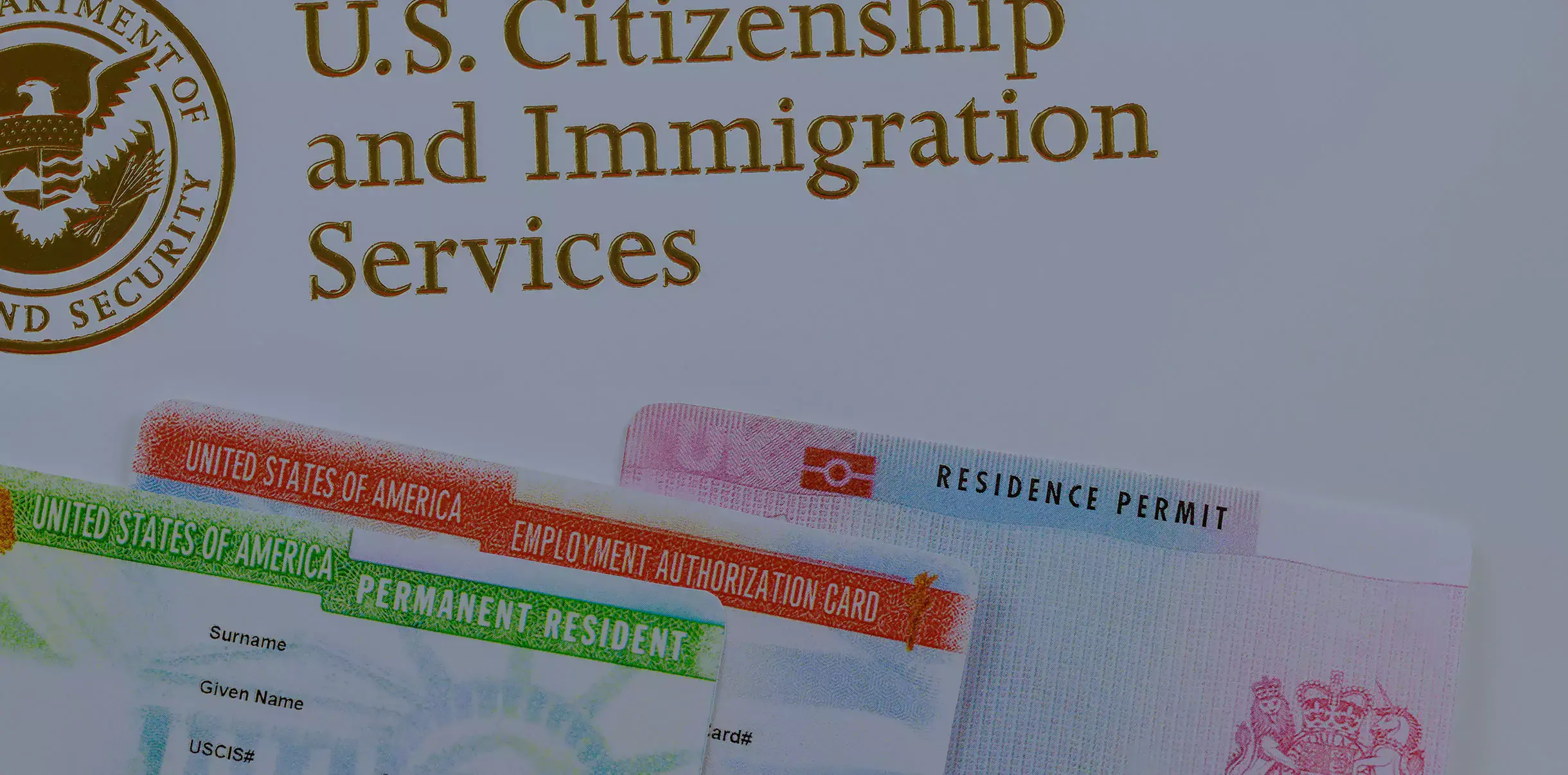
Green Card Adjustment of Status: Eligibility, Process & Timeline
What Is Adjustment of Status for a Green Card?
Adjustment of status is the process of applying for lawful permanent residence while you are physically present in the United States. Instead of returning to your home country to apply at a U.S. consulate abroad, you file Form I-485, Application to Register Permanent Residence or Adjust Status, directly with USCIS. The legal basis for adjustment of status comes from INA Section 245(a), which allows eligible applicants to become permanent residents without departing. Adjustment of status is available across multiple immigration categories, including family-based green cards and employment-based green cards.
There are two pathways to permanent residence, and which one applies depends on where you are when you file. Applicants inside the United States go through adjustment of status, while applicants outside the country go through consular processing with the U.S. Department of State.
What Is the Difference Between Adjustment of Status and Consular Processing?
Adjustment of status is filed with USCIS inside the United States, while consular processing takes place at a U.S. embassy or consulate abroad. With adjustment of status, you submit Form I-485 and attend your interview at a local USCIS field office. Consular processing works differently: you submit Form DS-260 and interview at the embassy in your home country. Leaving the United States during AOS without approved advance parole (Form I-131) can cause USCIS to treat your case as abandoned.
|
Factor |
Adjustment of Status |
Consular Processing |
|
Applicant location |
Inside the United States |
Outside the United States |
|
Agency |
USCIS |
U.S. Department of State |
|
Core form |
Form I-485 |
Form DS-260 |
|
Interview location |
Local USCIS field office |
U.S. embassy or consulate |
|
Travel during process |
Only with advance parole |
Not restricted |
Why Trust Pollak PLLC for Your Green Card Adjustment of Status
Managing Attorney Karen-Lee Pollak has dedicated 27 years exclusively to immigration law, handling adjustment of status cases across family, employment, and investment categories. Pollak PLLC has earned recognition from Chambers and Partners, D Magazine Best Lawyers in Dallas, Texas Super Lawyers, and Avvo Clients' Choice. Our firm has also stepped in to correct adjustment cases that other attorneys mishandled and has helped clients go from tourist-visa status to approved green cards. With offices in Addison, Texas, and Fort Lauderdale, Florida, we serve applicants across the country.
Do I Need a Lawyer to File Adjustment of Status?
You are not legally required to hire an attorney, but adjustment of status filings are detail-sensitive and increasingly subject to discretionary review. A single missing document in your initial evidence package can add six to nine months to your timeline through a Request for Evidence (RFE). Under the 2026 USCIS policy shift, officers now weigh positive and negative factors beyond statutory eligibility, which makes strong documentation and case preparation more valuable than it has been in years. Working with an experienced adjustment of status attorney reduces the risk of preventable delays, RFEs, and denials.
Who Qualifies to Adjust Status (and What Can Disqualify You)
INA Section 245(a) sets five general requirements for adjustment of status eligibility. You must be physically present in the United States and have been inspected and admitted or paroled, meaning you entered the country lawfully through a port of entry. An immigrant visa must be immediately available in your category, which is tracked through the Department of State Visa Bulletin each month. You must also be admissible. Grounds of inadmissibility, such as certain criminal convictions or prior immigration fraud, can block your case.
For most categories, you must have maintained continuous lawful status since your last admission. Immediate relatives of U.S. citizens, including spouses, unmarried children under 21, and parents, receive more forgiving treatment under the law. They are generally exempt from the bars that would otherwise block adjustment, including overstays and unauthorized employment.
What Disqualifies You from Adjustment of Status?
Several bars under INA Section 245(c) can prevent you from adjusting status, even if you were inspected and admitted or paroled at entry, and discovering that a past decision may affect your eligibility can feel overwhelming. The most common bars include:
- Entry without inspection (entering without passing through a port of entry)
- Unauthorized employment in the United States
- Failure to maintain lawful immigration status
- Certain criminal history that triggers inadmissibility
- Visa overstay (though immediate relatives are generally exempt)
- The J-1 two-year home residency requirement
The 90-day rule creates additional risk for applicants who entered on a nonimmigrant visa and filed for a green card shortly after arrival. USCIS may treat this as evidence of preconceived intent to immigrate. Applicants who entered on a K-1 fiancé visa face specific adjustment restrictions. If you entered without inspection, the Section 245(i) grandfather provision may still offer a path, provided a qualifying petition was filed on your behalf on or before April 30, 2001.
The Step-by-Step Adjustment of Status Process
Most applicants file a package of forms with USCIS, often submitting the qualifying petition and the I-485 together in what is known as concurrent filing. The process generally follows these stages.
- File the qualifying petition. For family cases, this is Form I-130 (Petition for Alien Relative). For employment cases, this is Form I-140, often filed by the employer for categories like the EB-2 visa.
- File Form I-485 once an immigrant visa is available in your category, or concurrently with the petition if one is immediately available.
- Submit supporting documents, including Form I-864 (Affidavit of Support), Form I-693 (medical examination completed by a USCIS-designated civil surgeon), and Form I-130A if applicable.
- File optional Form I-765 for an Employment Authorization Document (EAD) and Form I-131 for advance parole if you need to work or travel while your case is pending.
- Attend a biometrics appointment for fingerprints and photographs, typically scheduled within a few weeks.
- Attend a USCIS interview at your local field office.
- Receive a decision, followed by your green card by mail if approved.
As of 2026, the I-485 filing fee is $1,440 and the I-130 filing fee is $675. EAD and advance parole applications filed concurrently with the I-485 are included at no additional charge. Fees change periodically, and you should verify current amounts on the USCIS website before filing.
Can I Work and Travel While My I-485 Is Pending?
To work while your case is pending, you will need an approved Employment Authorization Document through Form I-765, which typically takes two to five months to process in 2026. Travel outside the country requires approved advance parole through Form I-131, and leaving without it can cause USCIS to treat your I-485 as abandoned.
If your case is employment-based, AC21 (the American Competitiveness in the 21st Century Act) may allow you to change jobs after your I-485 has been pending for 180 days. This portability protection applies as long as your I-140 remains approved. If you hold H-1B or L-1 status, you can generally continue working under your existing visa while the case is pending.
How Long Does Adjustment of Status for a Green Card Take?
Most family-based I-485 cases take roughly 8 to 14 months from filing to approval based on current USCIS data and the Department of State Visa Bulletin, as of 2026. Employment-based cases range from 9 to 35 months depending on the category and service center workload. The overall timeline from initial filing to green card in hand commonly runs 12 to 24 months, though cases with priority-date backlogs can take significantly longer. Processing speed varies by USCIS field office, and offices with heavier caseloads tend to schedule interviews later. After approval, your green card typically arrives by mail within two to three weeks, and you may begin your path to U.S. citizenship and naturalization as early as three to five years after becoming a permanent resident.
What Is the Adjustment of Status Timeline by Category?
The table below reflects estimated processing times as of 2026. These ranges cover the period from I-485 filing to final decision and do not include any priority-date wait that may apply before you can file.
|
Category |
Typical Processing Time |
Notes |
|
Immediate relative of U.S. citizen |
~8–14 months |
Fastest category; no priority-date wait |
|
Spouse of green card holder / family preference |
~14–35 months |
Priority-date dependent; longer waits common |
|
Employment-based (EB-1, EB-2, EB-3) |
~9–35 months |
Interviews sometimes waived; varies by service center |
|
Backlogged categories (India/China EB-2/EB-3) |
Years of wait before I-485 filing |
Priority-date retrogression delays when the case can be filed |
Immediate relatives of U.S. citizens receive the fastest processing because their category always has visas available and does not require a priority-date wait. Family preference and employment-based applicants often wait months or years for a visa number to become current before they can even submit their I-485.
What Can Delay Your Adjustment of Status?
Requests for Evidence are among the most common causes of delay, and they typically result from missing or incomplete documentation in the initial filing package. Biometrics appointments are usually scheduled within a few weeks of filing, but interview scheduling at USCIS field offices can take 6 to 18 months depending on location. The Dallas/Irving and Miami/Kendall field offices, which serve applicants near our firm's locations, each run on their own interview schedules.
After the interview, a final decision usually comes within 30 to 90 days, though background-check holds can extend this window. Priority-date retrogression can freeze employment-based cases for months or years when demand exceeds the annual per-country visa cap.
How the 2026 USCIS Policy Change Affects Adjustment of Status Applicants
On May 21, 2026, USCIS issued Policy Memorandum PM-602-0199, reframing adjustment of status as an "extraordinary" form of discretionary relief rather than a routine processing step. Under this guidance, consular processing is now positioned as the standard pathway for most green card applicants, and USCIS officers are directed to apply a totality-of-the-circumstances review when deciding whether to approve an I-485. Meeting the statutory eligibility requirements under INA Section 245 is no longer treated as sufficient on its own.
Officers may now request evidence of positive equities, such as strong family ties in the United States, long-term lawful presence, and community contributions. If you have any prior violations, periods of unlawful presence, or a history on a non-dual-intent visa like an F-1, the new policy introduces a level of scrutiny that did not exist before. We understand how unsettling that uncertainty can feel. If you hold a dual-intent visa such as H-1B or L-1, you have some protection under the guidance, though it is not automatic. The statute itself has not changed, and USCIS continues to accept I-485 filings across all eligible categories.
Is Adjustment of Status Still Worth Filing in 2026?
For many applicants, yes. Immediate relatives of U.S. citizens with clean immigration histories and strong positive equities remain well-positioned to adjust status under the new framework. The 2026 guidance raises the standard for how officers evaluate each case, which makes thorough preparation more important. Getting your case professionally screened before filing is more valuable than it was even a year ago. An experienced immigration lawyer can identify potential weaknesses and build the documentary record that officers expect under the new standard. If your history is complex, you should carefully weigh adjustment of status against consular processing with legal counsel before deciding which pathway to pursue.
Secure Your Future, Start Your Case
Family Immigration & Citizenship

Get Help From Our Dallas & Fort Lauderdale Family Immigration Lawyer Today
At Pollak PLLC, our Texas Family Immigration lawyer is standing by, ready to help you navigate the application process. Call us at (214) 307-5510 or contact us online for a fully confidential initial consultation. We provide immigration law services in Dallas & Fort Lauderdale and throughout the surrounding region. Our managing attorney, Karen-Lee Pollak and the experienced immigration support team, will work with you to determine the best possible employment preference category for you.
Testimonials
Working Together To Serve Your Needs
"Prior to deciding to utilize the legal services of Karen-Lee Pollak, I interviewed 11 different lawyers in the Dallas area to understand who was the most knowledgeable of immigration and naturalization laws. I strongly felt Karen was the most capable and professional of the individuals I examined. Karen provided invaluable support along the path towards receiving my American citizenship, both legally and personally. If I had a question or concern, Karen was always available to listen and to give sound council. Rather than giving up, Karen believed in me and continued to file for appeals, even in the face of adversity. Without any hesitation, I strongly recommend to anybody, Karen Lee Pollak for their naturalization needs."
Alexander Toulbou
American Citizen
“It is without reservation that I provide this reference for Karen Pollak. Her integrity, attention to detail, creativity, competence, and personal service are unmatched by almost all immigration attorneys. I have personally observed her counsel and guide many institutions and individuals through employment visas, religious visas, green cards, and citizenship. I have also witnessed her work remedying potential disasters created by less skilled and conscientious immigration practitioners. You would be hard pressed to find a more competent and caring counselor for an immigration issue.”
Patrick K. Craine
Former Partner at Bracewell & Giuliani LLP
“In 2005, I sought a H-1B visa for an experienced publishing executive in the UK I had identified as a key to my company's future growth. Our petition, submitted by another immigration attorney, did not pass muster and was denied. Discouraged, but still determined, I met with Ms. Pollak. Her confidence, command of the immigration process, and no-nonsense approach was refreshing. I am pleased to say our 2006 application was successful. We are now in the process of using Ms. Pollak to obtain my key employee’s green card.”
Victor Horne
QuestCorp Media Group
"Our road with Pollak immigration and Karen Pollak started in about 2018 when we had some problems with issuing our green cards, and Karen Pollak managed to navigate a complex part of the immigration law that's not well known and successfully got our green cards for us. Anyway, a number of years later, we are now proud citizens of the United States, and my thanks to Karen Pollak and Pollak Immigration for the excellent years of work and service that they have provided my family and I, without which we would probably not have got to where we are today."
Andre Oosthuisen
Client of Pollak PLLC
"Our team needed help from Pollak Immigration attorneys with H1B visas, H1B transfers, and EB2 visas. Before we reached out to Pollak Immigration attorneys, we faced the immigration challenges of our employees under this particular classification being deported. The outcome of our cases has been successful, and it’s been really exciting to see how something like this can change an employee’s experience. I believe it is due to the thorough nature of Karen and her team, just clearly outlining the needs for these particular classifications to be approved. I would tell someone considering Pollak Immigration Attorneys not to hesitate with partnering with this team."
Carla Boudreaux Gonzales
HR Manager, All First Financial Advisors
"The specific need or the type of visa I needed was a permanent resident or green card. The first challenge I faced before I reached Karen Pollak was that I entered the US on a tourist visa. This was not the right way to do it because I was planning to spend a lot of time, so I tried to reach other lawyers, and I didn't like the way the interviews went. It seemed like we were another person or another customer from the many they had, and we didn't feel a personalized relationship, and honestly, we didn't think it was going to work. So a friend of ours recommended Karen, at Pollak Immigration and everything was perfect, everything ran very smoothly, and after we reached Karen, it was very clear, the steps we needed to take. The outcome, was incredible as today we have our permanent residence or the green card, and we are also recommending Karen to another friend and family that need to put in order their immigration."
Ricardo Garate
Entrepreneur
"I am a U.S. citizen, and my parents are from Mexico. They moved to the US to be able to get their green cards. It wasn’t until we found Karen and her team that we had an amazing experience. My parents were able to get their green card. I couldn’t be more thankful to Pollak Immigration and the entire team. It was such a pleasure working with you."
Pattryze Garate Solano
Client of Pollak PLLC
"I needed to convert our E2 visa to an L1 and L2 dependent visa. Our original L1 application was denied due to a lack of evidence submitted by another attorney. The first attorney completely botched our application. This is when I found Karen Pollak and her team. I was impressed by her track record and amazing reviews from her existing and past clients. Right from the beginning, Karen had a clear idea of how to help us and what was needed. We were approved. Since the original application, Karen has helped us renew our L1 and L2 visas and apply for green cards. My family and I are now green card holders. This was our dream come true. Karen's team is very responsive, and the way they communicate is unbelievably fast and professional. Karen Pollak is hands down the best immigration lawyer I have ever had the privilege to work with."
Magdalena McCleod
Owner, Happy Business, LLC
"Moving to the US can be a challenge. Karen certainly is on top of her game. She understood exactly what was required and assisted us in making sure that we had everything that was needed before she submitted the application. Everything went smoothly, and so far, we have been living in the U.S. for just over a year now. Thanks to Karen’s assistance."
Andrew Skelton
Entrepreneur
"I am a trial lawyer, and when immigration issues come up, I have always entrusted my good friend and very respected colleague Karen Pollak and Pollak Immigration. Karen has been incredibly responsive. Everybody likes her, and she seems to have solved every one of their problems. And I could not give a higher recommendation to Karen Pollak and Pollak Immigration."
Michael K. Hurst
Partner; Lynn, Pinker, Hurst & Schwegmann
Start Your Green Card Adjustment of Status With Pollak PLLC
Filing for adjustment of status in 2026 requires more preparation and strategic planning than it did even a year ago. Pollak PLLC works with you to evaluate your eligibility, prepare a thorough I-485 package, and file with the attention to detail that today's review process requires. Managing Attorney Karen-Lee Pollak brings decades of focused immigration law experience to every case, and our firm has guided applicants from initial filing through approval across every major green card category.
Whether you are in the Dallas area or South Florida, we are ready to evaluate your case and build a filing strategy. Our firm serves clients in Plano, Frisco, Irving, Arlington, Richardson, and Garland in Texas, and across Hollywood and Pompano Beach in Florida.
Call our office at (214) 307-5510 to schedule a consultation, or contact us online.
Dallas
Take the First Step, Explore Your Options
Contact us today to speak with our Managing Attorney Karen-Lee Pollak and our experienced immigration support team.